
AI is rewriting the rules of life sciences marketing faster than most teams can read them. This creates both opportunity and risk. Used well, AI can sharpen your strategy, improve the quality of your creative output, expedite decision-making, and help you get found in places traditional search never could. Used carelessly, however, it can flatten your unique voice, invite compliance problems, and chip away at the credibility you have spent years building.
What separates those two outcomes is judgment. Human judgment.
Where AI Helps
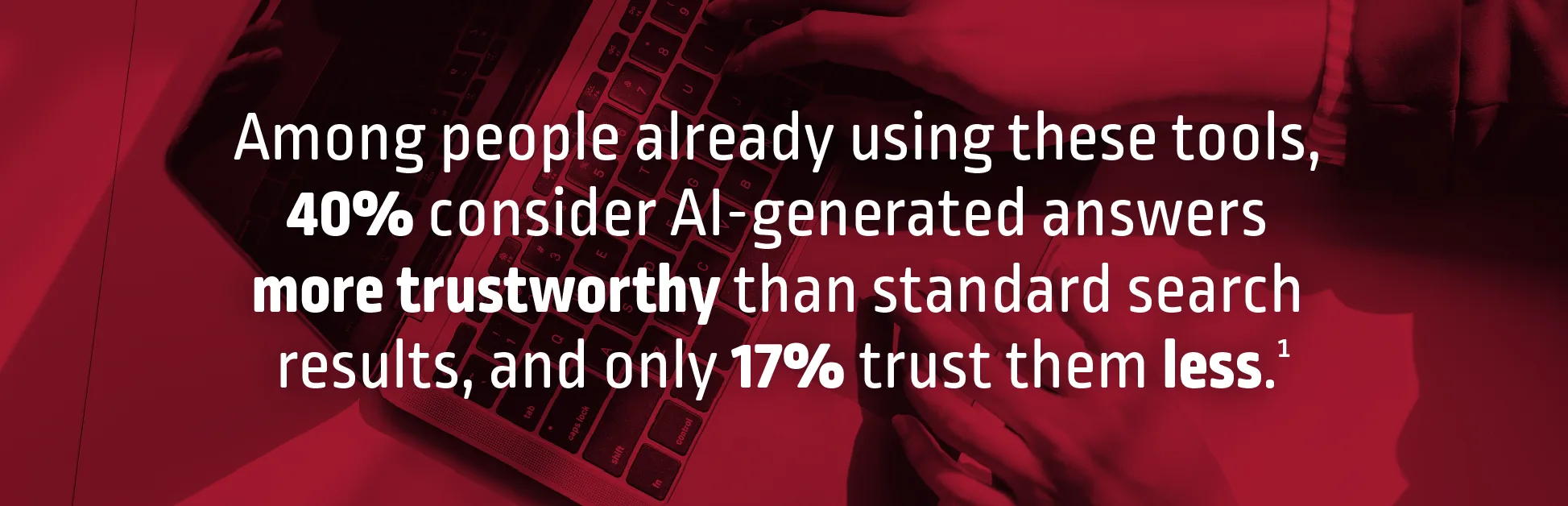
AI search has already changed how buyers find you. More than a third of consumers under 40 in the UK, and 32% in the US, now use AI for at least half of their searches.¹ When they do, they tend to trust what they get back. After all, AI can seem very confident in its findings even when it’s dead wrong. Among people already using these tools, 40% consider AI-generated answers more trustworthy than standard search results, and only 17% trust them less.¹
Generative Engine Optimization (GEO) is the practice of structuring your content so AI tools can easily find and cite it as a credible source of information. Unlike paid search, generative AI is not pay-to-play, so brands cannot buy their way into a search result.¹ Instead, the highest visibility goes to the companies that earn it by creating authoritative, well-structured content. Basically, while it’s still important, good SEO no longer covers you completely. We break GEO down in our full blog.
AI also shines as a starting point for creative and content work. McKinsey puts marketing and sales among the four business functions that capture roughly 75% of generative AI’s total potential value and ranks life sciences among the industries with the most to gain.² The strongest early use we see is ideation. This means getting past a blank page, finding fresh angles, testing concepts, and other idea generation steps. Here, AI can give a team a faster, more focused jumping-off point, though it does not substitute for the spark of a great idea or the human judgment that follows.
AI visuals have a role at this stage too, as long as everyone treats them as potential direction. An AI-generated mockup can be a fast way for a client and our team to get on the same page about how something looks or feels before production starts. It should be used as a shared reference, not as a finished asset.
Where AI Hinders

Writing
Left to its own devices, AI writes like everyone else in the industry. Without careful training on your voice, positioning, approved claims, and other factors, it produces copy that is completely competent and utterly forgettable. It’s just jibber jabber, and it won’t land effectively with your audience. Scientists, clinicians, and regulatory professionals know shallow content when they see it, and when your messaging reads like every other company in your category, you lose the differentiation that wins business.
Being another ripple in the Sea of Sameness gets expensive fast in a field where credibility is currency.

Visuals
AI visuals are no longer a fringe choice. Industry estimates attribute AI tool use to roughly 70% of social media images, and 62% of marketers now use generative AI for image creation.³ That ubiquity makes the trust issue urgent. Drawing on responses from more than 30,000 adults across 25 countries, Getty Images found that close to 90% of consumers want to know when an image was generated by AI, and 98% say authentic images and videos are essential to building trust.4 Those expectations are highest in trust-dependent sectors like healthcare and pharmaceuticals.4
As we’ve seen through regular updates, the technology keeps improving — sometimes minutely, sometimes massively — with 76% of people now agreeing it is getting hard to tell whether an image is even real.4 Getty’s research does give us a useful tactical point, which is that AI depictions of non-human subjects read as less misleading than AI images featuring real people or products,4 which gives life science marketers a safer lane when they do choose AI visuals.
Academic evidence supports caution. A 2025 peer-reviewed study in Administrative Sciences found that once consumers were told an image was AI-generated, their trust, attitude, and purchase intent dropped significantly compared with human-made work.5 When the source went undisclosed, consumers rated AI and human images about the same.5 The same study found that the reason you give for using AI changes how people react to visuals. Namely, when researchers framed AI use around privacy protection, evaluations of AI images matched those of human-made images. When they framed it around cost savings, trust and purchase intent dropped.5
There are production realities too. Before you build a brand asset on an AI-generated image, weigh these four issues:

Compliance risk compounds from there. AI generates content that sounds authoritative, which is precisely what makes its errors dangerous. Every AI-assisted asset in this space needs expert human review. Treat that review as part of the work.
Overreliance carries another, quieter cost. Lean on AI too heavily and it smooths out the edges that make your content uniquely yours. Your scientists, your researchers, and your clinical insight are your advantage, and they are difficult to replicate with AI. Used well, AI amplifies those experts and frees them for higher-value thinking. It should never stand in for them.
The Dividing Line
Research on how consumers feel about AI seems to contradict itself, and the reason comes down to disclosure. Studies that test reactions without telling people AI was involved tend to look favorable, while studies that measure attitudes after disclosure tend to raise red flags. In Zappi’s research on 1,000 US consumers, roughly a third say they like AI in advertising, a third feel neutral, and a third dislike it. Even so, 52% say it makes no difference to how they view a brand, and that figure climbs to two-thirds among consumers aged 56 to 75.⁶
This might read as a contradiction of the earlier finding that nearly 90% of consumers want AI use disclosed, but they fit together. Wanting to be told is different from penalizing a brand after you are. Most people just want the choice, and honest disclosure rarely ruins the relationship. Concealment is the bigger risk, because trust lost after the fact is far harder to win back.
Spotting AI is also harder than people assume. Only a third of consumers believe they can identify AI in an ad.6 When Zappi tested a Puma campaign built with AI, audiences could not tell. They responded to the story and the emotion instead of hunting for flaws.6 The lesson here is that whether or not AI ever touched the work, an ad grounded in real human insight and emotion performs, while one that doesn’t falls flat.
The Bottom Line
AI is a genuinely powerful tool, and a tool it should remain. It performs best only when guided by vast industry knowledge, a clear brand strategy, and the experienced judgment to make the right moves in a highly regulated, highly trust-dependent field. The brands that come out ahead will be the ones using AI with discipline and transparency, while keeping human expertise at the center of the work.
At SCORR, we combine leading-edge technology with elite creative and scientific expertise to produce marketing that is inventive and trustworthy. Because your marketing should hold up to the same level of scrutiny as your science.

Frequently Asked Questions
What is Generative Engine Optimization (GEO)?
GEO is the practice of writing and structuring content so AI-powered tools like ChatGPT, Perplexity, and Google’s AI Overviews find and cite it in their answers. It builds on traditional SEO but targets conversational AI search rather than ranked lists of links. Because generative AI is not pay-to-play, brands cannot buy a mention, so visibility goes to companies that publish clear, authoritative, well-organized content.¹
Can AI-generated images be used in life science marketing?
Yes, in the right places. AI imagery works well for early concepting, mockups, background or filler visuals, and cleaning up existing photography. It is riskier for final, public-facing assets, because AI images carry no copyright protection, often lack print-quality resolution, arrive as flat files with no working layers, and can render clinical settings inaccurately. In a regulated field, every AI-assisted visual should pass through human review for accuracy and compliance before it goes public.
Do brands need to disclose when they use AI in marketing?
Disclosure is increasingly expected. Close to 90% of consumers want to know when an image is AI-generated, and 98% say authentic visuals are essential to trust.4 Research shows disclosure can lower how consumers rate AI work, yet concealment carries its own risk if it comes to light later. For life science brands built on trust, transparency paired with genuinely high-quality, human-guided work is the more durable path.5
References
1 Attest. 2025 Consumer Adoption of AI Report. 2025. https://www.askattest.com/blog/articles/2025-consumer-adoption-of-ai-report
2 McKinsey & Company. The economic potential of generative AI: The next productivity frontier. June 2023. https://www.mckinsey.com/capabilities/quantumblack/our-insights/the-economic-potential-of-generative-ai-the-next-productivity-frontier
3 AutoFaceless. AI Image Generation Statistics 2026. April 2026. https://autofaceless.ai/blog/ai-image-generation-statistics-2026
4 Getty Images (VisualGPS). Nearly 90% of Consumers Want Transparency on AI Images finds Getty Images Report. 2024. https://newsroom.gettyimages.com/en/getty-images/nearly-90-of-consumers-want-transparency-on-ai-images-finds-getty-images-report
5 Zhang, L., & Hur, C. The Impact of Generative AI Images on Consumer Attitudes in Advertising. Administrative Sciences (MDPI), Vol. 15, October 2025. https://www.mdpi.com/2076-3387/15/10/395
6 Zappi. How consumers feel about the use of AI in advertising. June 2025. https://www.zappi.io/web/blog/how-consumers-feel-about-the-use-of-ai-in-advertising/


Alyssa Greiner

Carrie Svoboda