
As more professionals turn to tools like ChatGPT and Google Gemini to research potential solutions, life science companies need to rethink how they’re showing up online. Generative engine optimization (GEO) is about making sure your business is discoverable and accurately represented in the AI-driven answers these tools deliver.

In this blog, we’ll walk through what GEO means, how it differs from traditional SEO, and the steps your organization can take to stay competitive in the AI search landscape.
What is generative engine optimization, and why is it important?
GEO is the practice of optimizing your website and content so it’s discoverable and usable by large language models (LLMs) like ChatGPT, Google Gemini, Perplexity, and others. Instead of targeting traditional search engines like Google and Bing, GEO ensures your content is part of the context AI tools use to answer user questions. As more people shift from typing keyword-based searches into Google to asking direct questions in AI tools, it’s crucial that your site is structured to provide clear, helpful answers that these models can reference.
Additionally, GEO is based on a holistic view of your digital presence: not only your own site, but also how others talk about you across discussion forums, reviews, publications, and elsewhere on the web. Establishing a strong reputation management strategy is an essential part of optimizing for these factors.
If my site is already optimized for search engines, how is GEO different?
There is some overlap between life science SEO and GEO. For example, an analysis from Surfer found that 52% of sources mentioned in Google’s AI Overviews also appear in the top 10 organic search results. However, that means nearly half don’t. The bottom line is that ranking well in search doesn’t guarantee your site will be included or accurately represented in AI-generated responses.
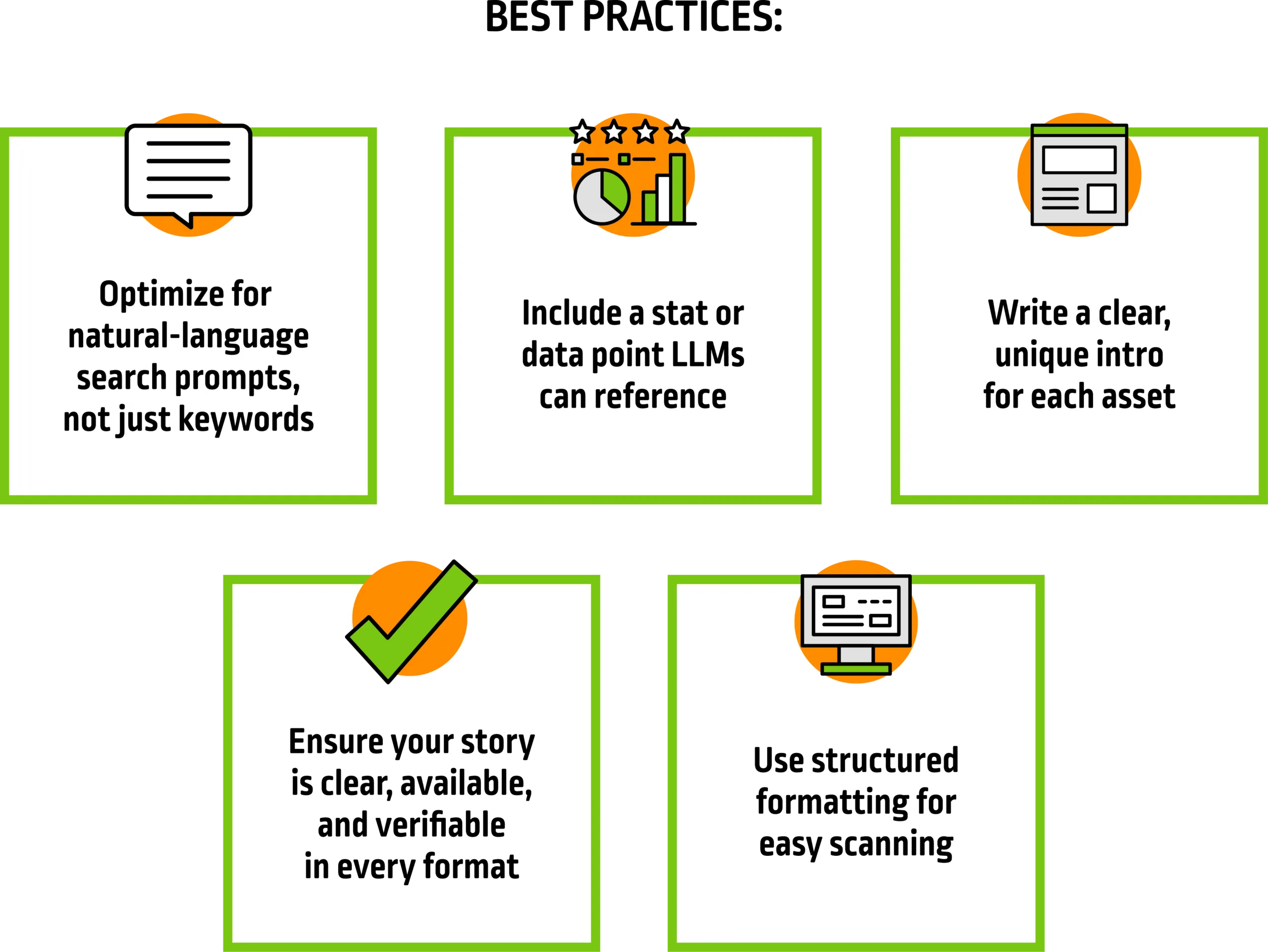
So, what do you need to do to bridge the gap between SEO and GEO for life sciences? While traditional SEO focuses on optimizing for keywords, GEO focuses on search prompts: the more conversational questions people ask AI tools. This approach is closely tied to Answer Engine Optimization (AEO), which involves structuring your content to directly answer those questions in a way LLMs can extract and synthesize. Creating content that is effective for AEO requires a balance between the scientific language that builds credibility and the conversational tone LLMs prefer when answering user queries.
On a technical level, GEO’s foundational best practices are similar to SEO: making your site crawlable, structuring content clearly, and using schema markup. But there are also new considerations, like optimizing for context over keywords, leveraging tools such as adding an llms.txt file to your website, and understanding how LLMs interpret meaning across related terms.
How can I balance lead generation and generative engine optimization when it comes to gated content?
Since gated content isn’t accessible to LLMs, your success with GEO hinges on how well you optimize the part that is visible: the summary page. This page needs to provide meaningful, scannable context that LLMs can use, while also leaving users interested in downloading the full resource to learn more.
How can I make sure my content is optimized for AI search without compromising quality?
Striking the right balance between the professional tone life science companies often prefer and the more conversational style that resonates with AI search tools is key. This may involve adapting diverse types of content to serve different goals. For example, the summary page of gated content offers an opportunity to be a bit more informal, while the full piece can remain more technical. Using this approach allows you to adapt to GEO standards without compromising the unique voice and professionalism of your brand.
What technical challenges should I expect when adapting my existing website for GEO?
One of the biggest challenges is that many companies still haven’t fully optimized their websites for SEO. Without that foundation, GEO becomes much harder. Before jumping into GEO-specific tactics, ensure your site has strong, well-structured content. For example, many sites have thin pages that lack enough depth to rank effectively, even for traditional SEO. On top of that, technical issues like poor site architecture or missing schema often need to be addressed. Once those fundamentals are in place, GEO is the next layer to help you stand out in AI-driven results and stay ahead of competitors.
What role does PR play in GEO?
PR and earned media have always been valuable for SEO, but they play an even bigger role in generative engine visibility. Public relations is inherently prepared with the expertise of sharing narratives, building authority through media placements, and ensuring message consistency. Tools like ChatGPT pull from a wide range of third-party sources to build contextual understanding. That means the more your company and key thought leaders are mentioned in credible, relevant outlets, the more likely you are to appear in AI-generated responses. Press releases, thought leadership articles, and media coverage can all serve as external validation to support an LLM’s “context map,” the information the model uses to generate responses and complete tasks.

I want to optimize my website for generative engines. What should I do first?
The first step is to look at your website from an unbiased perspective. Often, there’s a gap between how your internal team views your brand and how it’s actually being interpreted by LLMs. That disconnect is exactly what GEO can help resolve, and it starts with understanding current perception and identifying what needs to shift.
A comprehensive GEO audit can give you a clear baseline of where your web presence and authority stand today and what foundational gaps need to be addressed. Because generative engine optimization is still a new concept for life science marketing, this kind of audit can often uncover low-hanging fruit and where to focus your long-term strategy.
Want to know how your website measures up? Reach out to SCORR for your GEO audit. We’ll assess your site’s readiness, identify opportunities, and build a tailored strategy to help your content rise to the top in AI-driven search.

Tim Harkleroad

Marc Bacon